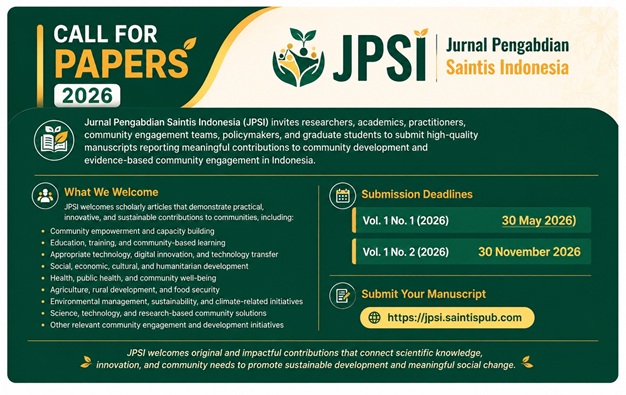













Jurnal Pengabdian Saintis Indonesia (JPSI) is an academic journal dedicated to the contributions of scientists, academics, and practitioners in developing research-based solutions to social, educational, health, environmental, and humanitarian challenges in Indonesia.
The journal aims to provide an open platform for scientists, researchers, policymakers, and community engagement practitioners to share findings, perspectives, and innovations that can contribute to positive developments in society, education, and the quality of life of communities across Indonesia. JPSI prioritizes scientific quality by publishing rigorous, relevant, and meaningful articles addressing various aspects of community engagement and community-based development.
Through the publication of high-quality scholarly articles, JPSI seeks to encourage collaboration among researchers, practitioners, and policymakers in developing innovative and evidence-based solutions that can be directly implemented to address real-world challenges. The journal therefore serves as a scholarly platform for connecting scientific knowledge with practical community needs. By integrating research, innovation, and community engagement, JPSI seeks to accelerate positive change and contribute to sustainable improvements in the social, educational, economic, health, environmental, and humanitarian conditions of communities in Indonesia.
Before Making a Submission
Originality & Template
- Manuscripts must be original, unpublished, and not under consideration for publication elsewhere.
- Authors must use the official Template.
Quality & Tools
- All manuscripts are subject to a mandatory similarity check using Turnitin.
- References must be managed using Mendeley, Zotero, EndNote, or other recognized reference management software.
Rejection Policy
- Manuscripts may be rejected automatically if they do not comply with the Author Guidelines.
- Manuscripts submitted in a different format or with incomplete administrative requirements may be rejected without further processing.